Health & Safety policy
Morro’s Health & Safety Policy is a cornerstone of its operational philosophy, integrating safety management directly into its core business functions and fulfilling all relevant UK health and safety legislation and legal responsibilities.
Key Aspects of the Policy:
• Secure Environment: The primary objective is to provide and maintain a safe and secure environment for all residents, staff, contractors, and visitors.
• Structured Management Plan: This commitment is articulated through a detailed Health & Safety Plan. This plan is the operational blueprint for implementing risk management protocols and enforcing specific safety standards across all Morro’s properties and activities.
• Continuous Review and Improvement: To ensure relevance and effectiveness, the policy and the associated plan are subject to rigorous, periodic reviews, occurring at least annually or as necessitated by changes in law, operations, or risk profiles.
• Communication of Intent: A formal General Statement of Intent is a key document that ensures the Morro’s commitment to health and safety is clearly communicated to all employees, fostering a universal safety culture.
• Defined Responsibilities and Accountability: The policy explicitly defines the health and safety responsibilities of all personnel, from senior management to entry-level staff. Accountability is enforced through the mandatory completion and review of safety records and documentation.
• Compliance and Internal Procedures: Morro adheres strictly to relevant UK legislation and employs specific internal procedures to proactively manage and mitigate various safety topics and potential hazards.
This structured approach ensures a proactive, compliant, and consistently safe environment for the entire Morro community.
Scape and Morro Group “the Group” (Scape Operations LTD, Scape UK Management LTD, Scape Student LTD, Scape Developments LTD) recognises that it has responsibilities for the health and safety of our workforce whilst at work and others (residents, contractors, visitors) who could be affected by our work activities. We will assess the hazards and risks faced by our workforce in the course of their work and take action to control those risks to an acceptable, tolerable level. Our managers are made aware of their responsibilities and required to take all reasonable precautions to ensure the safety, health and welfare of our workforce and anyone else likely to be affected by the operation of our business. Morro intends to meet its legal obligations by providing and maintaining a safe and healthy working environment so far as is reasonably practicable. This will be achieved by:
• providing leadership and adequate control of identified health and safety risks.
• consulting with our employees on matters affecting their health and safety.
• providing and maintaining safe plants and equipment.
• ensuring the safe handling and use of substances.
• providing information, instruction, training where necessary for our workforce, taking account of any who do not have English as a first language.
• ensuring that all workers are competent to do their work and giving them appropriate training.
• preventing accidents and cases of work-related ill health.
• actively managing and supervising health and safety at work.
• having access to competent advice.
• aiming for continuous improvement in our health and safety performance and management through regular (at least annual) review and revision of this policy; and
• the provision of the resource required to make this policy and our health and safety arrangements effective.
We also recognise:
• our duty to co-operate and work with other employers when we work at premises or sites under their control to ensure the continued health and safety of all those at work; and
• our duty to co-operate and work with other employers and their workers, when their workers come onto our premises or sites to do work for us, to ensure the health and safety of everyone at work.
To help achieve our objectives and ensure our employees recognise their duties under health and safety legislation whilst at work, we will also remind them of their duty to take reasonable care for themselves and for others who might be affected by their activities.
These duties are explained on first employment at induction and set out in an Employee Safety Handbook, given to each employee, which sets out their duties and includes our specific health and safety rules
To maintain high safety standards, we periodically evaluate our Health and Safety Policy and arrangements. The history of these reviews is documented below.
Date | Name of reviewer | Outcome |
March 2026 | Akin Akinkunle & Gina Helgiu | Review and restructure in line with the ISO45001 audit |
Although the Board of Directors have overall responsibility for the implementation of this policy day to day responsibility for specific issues has been delegated to key personnel.
The management structure within our business is shown here, and a location of day- to-day responsibility for specific health and safety issues is shown in the Responsibility Chart which appears later in this document.
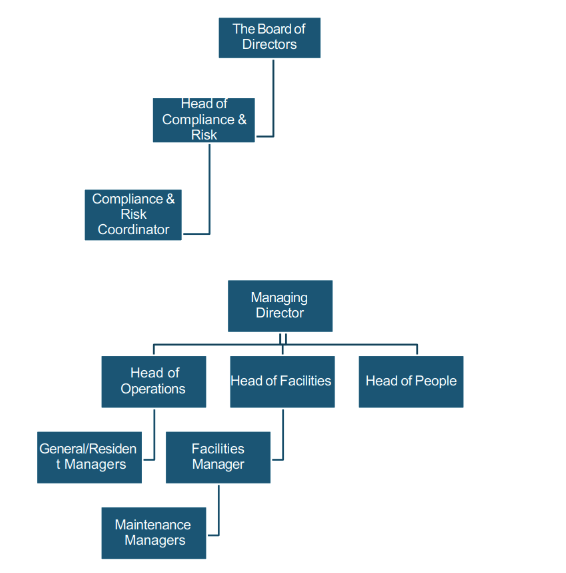
Managing Director:
The Managing Director holds overall responsibility for health and safety within Morro. They will ensure that qualified personnel and adequate resources are in place to implement this Policy fully. In collaboration with all employees, the effectiveness of this Policy will be monitored, providing clear guidance on health and safety matters. This will include the development of initiatives related to the Company Improvement Plan (where appropriate).
Heads of Department (Compliance, FM & Operations):
At the operational level, the Heads of Operations and Facilities Management are responsible and accountable to the Managing Director for implementing Morro’s health and safety policy.
This will include taking all reasonable steps to:
- Ensure effective implementation and active supervision of the company’s health and safety policies.
- Ensure adequate risk assessments have been carried out in co-ordination with the MD and those who are to carry out the work and that appropriate control measures and safe systems of work are put in place.
- Ensure that accidents, incidents and near misses are recorded, reported and investigated.
- Identify and inform the MD of their own health and safety training needs and the training needs of their teams.
- Continually monitoring their area of responsibility to ensure safe working practices are being employed and that unsafe working practices are corrected.
- Ensure effective two-way communication of health and safety information between management and those working under their supervision.
- Ensure when new or temporary workers are employed within their area of responsibility they receive an appropriate level of information, instruction and training regarding the health and safety requirements of their task prior to them starting work.
- Assist with the review of procedures and systems used in their responsibility with the MD.
Head of Compliance:
- Ensure compliance with all relevant legislation and the internal standards adopted by Morro.
- Develop and promote Morro’s health and safety strategy, providing specialised advice and training to achieve high standards of health, safety, and risk management in accordance with Morro’s policy.
- Enhancing awareness of health, safety, and risk management throughout site operations and foster a positive safety culture.
- Provide professional support to management and employees regarding health and safety matters
- Facilitate regular and systematic health and safety audits across Morro's operations in collaboration with senior management.
- Assist in identifying practical solutions to health and safety issues.
- Advise staff to maintain a safe work environment.
- Promote a policy requiring that all accidents, incidents, and near misses be reported, recorded, and investigated, with recommendations for remedial actions provided and implemented.
- Encourage monitoring of all accidents, incidents, and near-miss trends, using the gathered information to improve the Morro's health and safety management system and reduce incident rates.
General/Residence/Maintenance Managers
Site Managers play a crucial role in the communication process and collaborate closely with everyone under their supervision. This is particularly important when communicating Morro’s Health & Safety Improvement Plan. They provide direct feedback to their line managers regarding any issues or points that are raised.
Other duties will include the following:
- Maintain COSSH Assessment & data sheets for hazardous material.
- Conduct weekly fire safety checks, six-month evacuation drill and monthly emergency lighting checks.
- Ensure all work carried out is done within the statutory H&S requirements.
- Maintain risk assessment files of their respective departments, identify and recommend improvements where required.
- Working closely with the Compliance Team to implement and maintain all health and safety policies, and risk controls on site.
- Reporting all incidents in line with the business contingency plan.
- Implement relevant training for their team including reviews or e-learning courses.
Employees (Site & Office Staff)
Morro expects all employees to fulfil their responsibilities regarding health and safety and to ensure they:
- Take reasonable care for their health and safety and the health and safety of other people who may be affected by their acts or omissions.
- Know the health and safety measures, controls and arrangements to be adopted in their own work area and to ensure they are applied.
- Know and apply the emergency procedures in respect of fire, first aid, safety and any other emergency procedures relevant to their task or to the area they work in.
- Use any equipment, machinery, hazardous substance, transport equipment, safety device, or system of work in accordance with the information, instruction and training they have received and to refrain from using any item, piece of equipment or substance unless they have received adequate information, instruction and training to allow them to do so safely.
- Co-operate with Morro and other employees in promoting and improving safety performance.
- Report any concerns they may have about health and safety matters within their area of work to their manager or team leader at the earliest practical opportunity including asking their manager or team leader about any aspect of health and safety, which pertains to their job that they do not fully understand.
New Employees
- In addition to the requirements of the general employee, all new starters will be introduced and inducted with the contents of this policy. This process will run over the induction training programme, only when both the new starter and the managers are satisfied that the new starter is conversant with the requirements will they move on with specific training etc.
- During induction new starters must remain extra vigilant when carrying out all tasks and raise any concern they have with health and safety practices within the workplace. Assistance in this way will help us ensure that all new starters are aware of the correct way tasks are to be performed within Morro, also enable poor practices to be highlighted and actions taken to improve safety
Practical arrangements for specific risk areas are detailed below. All arrangements are supported by risk assessments and appropriate training.
1. Lone Working
This arrangement applies to all Morro employees who perform duties outside normal hours, in isolated areas of the buildings (e.g., maintenance staff in plant rooms, cleaning staff early morning/late evening, and night porter/security teams), during off-site errands, or when working in areas with reduced occupancy.
Key Responsibilities:
Management: Managers must conduct formal risk assessments for all lone working activities, provide appropriate training and supervision, and ensure effective emergency communication and response procedures are in place.
Employees: Staff are required to follow established procedures, attend all relevant training, use the provided safety equipment (Solo Protect devices), and report any incidents or concerns immediately.
Procedures and Control Measures:
Risk Assessment:
Formal risk assessments identify potential hazards (People, Environment, Tasks) such as workplace violence, accidents, or health issues.
Assessments consider the nature of the location (e.g., isolated areas, external patrols) and the specific tasks being performed.
Communication & Monitoring:
Regular check-ins (via phone, radio, or Solo Protect app/device features) are mandatory for all lone workers. The frequency of contact is determined by the risk assessment.
A buddy system or welfare check schedule may be implemented for certain shifts.
Solo Protect System Integration:
Device Utilisation: All designated lone workers are issued a Solo Protect personal safety device.
Features:
Red Alert: In an emergency or threatening situation, staff can discreetly raise a Red Alert via their device, which connects directly to the Solo Protect 24/7 Monitoring Centre.
Man Down/Incapacitation Alarms: The devices include automatic detection for slips, trips, or falls, triggering an alert if a worker is unable to call for help.
Geolocation: Real-time GPS tracking ensures emergency services can quickly locate the staff member in distress.
Incident Response: Clear, documented procedures are in place for the Monitoring Centre to contact relevant Morro management and emergency services immediately in the event of an alarm activation.
Training:
All lone workers receive comprehensive training on the lone working policy, hazard awareness (e.g., managing confrontational situations), and the correct operation of their Solo Protect device. This training is recorded for ease of future reference.
Training also covers the procedures for stopping work and seeking advice if a situation becomes uncertain or hazardous.
2. Personal Protective Equipment (PPE)
Morro is committed to providing a safe and healthy environment for all residents, staff, and contractors. Our approach to health and safety follows the hierarchy of control, using PPE as a supplementary measure to primary risk mitigation strategies such as engineering controls and safe systems of work.
This policy applies to all Morro staff, on-site contractors, and, where applicable, residents and visitors in specific situations as determined by a risk assessment.
2.1 Responsibilities
Morro Management:
Conduct comprehensive risk assessments to identify specific activities requiring the use of PPE.
Provide appropriate, certified, and well-maintained PPE to employees and contractors free of charge.
Ensure proper training is given on how to correctly wear, use, maintain, and dispose of PPE.
Regularly monitor compliance and review the effectiveness of the PPE provided.
Staff & Contractors:
Wear the provided PPE as instructed when performing identified tasks.
Report any damaged, lost, or ill-fitting PPE to their manager immediately.
Store and maintain PPE in designated areas as per the training and manufacturer's instructions.
Residents:
While residents are not typically required to use PPE for daily living, they must adhere to specific safety instructions, such as using appropriate (fire-retardant) linen, and not bringing hazardous substances into the building.
During specific communal events (e.g., certain cleaning activities, moving in/out during a health crisis), residents may be provided with and instructed on the use of necessary protective items (e.g., gloves, masks).
2.2 PPE in Practice at Morro
Cleaning & Maintenance:
Our on-site maintenance and housekeeping teams are provided with task-specific PPE, which may include safety gloves, eye protection, and aprons when handling cleaning chemicals, disposing of specific waste, or performing maintenance tasks (e.g., electrical work or dealing with bodily fluids).
Specific Health Situations (e.g., pandemic response):
In the event of an outbreak or specific health crisis, additional guidance will be implemented in line with GOV.UK health guidance and the Health and Safety Executive (HSE). This may require the use of face masks, gloves, and aprons for staff involved in close contact or cleaning potentially contaminated areas.
Waste Disposal:
Used PPE should be disposed of in general domestic waste bins and not recycled. In specific health situations, waste might require double-bagging and temporary secure storage before general disposal.
3. Violence at Work Policy and Arrangements
Morro defines "violence at work" as any incident in which a person is abused, threatened, or assaulted in circumstances relating to their work or stay. This includes physical violence, verbal abuse, intimidation, and harassment, whether by a resident, a visitor, a contractor, or another staff member.
Arrangements:
Risk Assessment: Morro management will conduct regular risk assessments across all locations to identify potential scenarios or areas (e.g., front of house, communal areas, night shifts) where the risk of violence might be higher. These assessments will inform preventative measures.
Preventative Security Measures:
24/7 Staffing: All Morro locations are staffed 24 hours a day by trained team members. This ensures immediate assistance is always available.
CCTV and Access Control: Comprehensive 24-hour CCTV surveillance is in place across all common areas, entrances, and perimeters. Secure fob access is required for building entry and access to specific floors and rooms, limiting unauthorised access.
Building Design: Morro designs focus on good visibility in communal areas and avoid potential 'trapping points' to enhance safety.
Staff Training:
De-escalation: All staff members, particularly those in resident-facing roles (front of house, residential assistants, management), receive training in conflict resolution and de-escalation techniques to manage potentially difficult situations calmly and effectively.
Health & Safety: Staff are trained in general health and safety protocols and emergency procedures.
Mental Health First Aid: A significant number of staff are trained in mental health first aid, enabling them to support residents and colleagues experiencing distress, which can be a factor in aggressive behaviour.
Incident Reporting and Investigation:
Clear Reporting Channels: Staff are required to report all incidents or near misses involving violence or aggression to management immediately. Residents can report issues via the Resident App or directly to the 24/7 reception team.
Support for Victims: Morro ensures that anyone who experiences violence or harassment receives appropriate support and that incidents are thoroughly investigated.
Disciplinary Action: Any act of violence or aggression will be subject to the full disciplinary process for staff, and the terms and conditions outlined in the Residence Agreement, which may include involving local law enforcement if necessary.
Communication and Information:
Visible Information: Clear signage and information are provided regarding expected behaviour, security measures, and how to seek help (e.g., security contact, emergency numbers).
Code of Conduct: Residents are made aware of the expected standards of behaviour and the zero-tolerance policy for harassment as part of the Morro Code of Conduct and booking terms.
4. Work Equipment
This section details how Morro ensures all work equipment used by staff and provided for residents' use is safe, regularly maintained, and compliant with the Provision and Use of Work Equipment Regulations (PUWER) 1998.
4.1. Scope and Responsibilities
Morro Management Teams are responsible for procuring, inspecting, maintaining, and certifying all company-owned or provided work equipment and appliances, ensuring they meet relevant safety standards (e.g., fire safety, electrical safety).
On-site Maintenance and Housekeeping Teams are responsible for conducting routine checks, reporting faults immediately, and performing approved repairs in a timely manner.
All Staff are required to use equipment in accordance with training and instructions, report any defects or damage immediately to the maintenance department, and ensure a safe environment for themselves and residents.
Residents are required by their tenancy agreements to maintain a reasonably safe environment in their rooms, use all supplied equipment appropriately, and report any maintenance issues promptly via the Resident App. They must not tamper with or misuse any provided equipment or building safety infrastructure (e.g., window restrictors, fire doors). Morro reserves the right to ask residents to remove any personal items deemed unsafe, such as e-bikes/e-scooters which are prohibited due to battery fire risks.
4.2. Procedures and Maintenance
A. Company-Provided Equipment
This includes shared laundry machines, vacuum cleaners (available for loan at reception), communal kitchen appliances (if applicable), and all equipment used by staff (e.g., cleaning machinery, tools, office equipment).
Procurement: All new equipment must be assessed for health and safety compliance before purchase and introduction into the building.
Maintenance & Servicing:
A planned preventative maintenance (PPM) schedule is in place for all major equipment and building systems (e.g., fire alarms, ventilation, heating).
Gas appliances (boilers, cookers) are subject to annual safety checks by a Gas Safe registered engineer, and a copy of the certificate is provided to residents and retained for records.
Electrical systems and appliances (TVs, fridges, microwaves, etc.) are subject to regular Portable Appliance Testing (PAT) and a full Electrical Installation Condition Report (EICR) every five years to ensure they are safe.
Instructions & Training:
Instruction manuals for in-room equipment are available on the Resident app and from the front of house team.
Clear instructions are posted in communal areas, such as laundry rooms, on how to use machinery safely.
Staff receive specific training on the safe use of all work equipment relevant to their roles.
B. Resident's Personal Equipment
Residents are permitted to bring personal electrical equipment, provided it is safe and certified (if electrical).
Morro staff may inspect items and require the removal of any item deemed unsafe.
Residents are encouraged to ensure personal electrical items have safe cabling and are used responsibly.
The use of deep fat fryers, anything with a naked flame (candles, incense), or hazardous substances is strictly prohibited in all areas of the building.
4.3. Reporting and Corrective Action
Any equipment failure, damage, or safety concern must be reported immediately to the 24/7 front of house team or via the Resident app.
Faulty equipment is immediately taken out of service (quarantined/decommissioned) until inspected and repaired by a competent person.
Repairs are tracked and prioritised to ensure minimal disruption and swift resolution.
4.4. Monitoring and Review
The effectiveness of these arrangements is monitored through regular workplace inspections, accident/incident reporting procedures, and annual reviews of the Health and Safety policy by the management team. This ensures continuous improvement in maintaining a safe environment for all Morro residents and staff.
5. Accident Investigation & Reporting
Morro is committed to the timely reporting, thorough investigation, and proactive prevention of accidents and incidents across all sites.
Initial Reporting: All incidents, accidents, and near misses must be reported immediately by the staff member who witnessed or was involved in the event, or the most senior person available. This is typically done via each site's dedicated Incident Reporting email address and recorded internally on the Morro reporting system.
RIDDOR Reporting: The Compliance & Risk Team is the designated 'responsible person' for determining if an incident meets the criteria for reporting to the Health and Safety Executive (HSE) under the Reporting of Injuries, Diseases and Dangerous Occurrences Regulations (RIDDOR). The Compliance & Risk Team will submit all necessary reports to the HSE via the official HSE Online Portal within the required timeframe.
Investigation Process:
Site Management Team: The local site management team leads initial investigations to gather facts, speak to witnesses, and secure the scene/evidence.
Compliance & Risk Department Support: The Compliance & Risk Department provides expert support and oversight, particularly for serious incidents or those with significant potential risk, to ensure impartiality and thoroughness.
Corrective Action and Learning:
The primary purpose of an investigation is to identify root causes and implement effective corrective and preventive actions.
"Lessons learnt" are formally captured, shared, and disseminated amongst relevant teams and across all Morro locations via established communication channels (e.g., Quarterly Compliance Meeting, Daily Huddle) to prevent recurrence.
Investigation outcomes are reviewed periodically at a senior management level to inform future risk assessments and policy reviews.
6. Control of Substances Hazardous to Health (COSHH)
Morro is committed to preventing work-related illness and disease from exposure to hazardous substances.
Staff Familiarisation: All relevant staff (Housekeeping, Maintenance, Front of House, and Management) are required to familiarise themselves with and sign the COSHH Assessments. This confirms their understanding of the risks and necessary control measures, including the use of Personal Protective Equipment (PPE) where required.
Documentation Access: COSHH Assessment folders are readily available in both the Housekeeping and Maintenance cupboards at each location.
New Product Introduction: A full COSHH Assessment must be conducted before any new hazardous product is introduced and used on-site. The Material Safety Data Sheet (MSDS) must be obtained from the supplier and reviewed as part of the assessment process. A COSHH inventory will be maintained, and risk assessments will be carried out for all hazardous substances.
Product Selection: Morro prioritises the use of non-hazardous or low-hazard products wherever possible to minimise risk.
Preferred Supplier: Bunzl is the preferred supplier for all cleaning and maintenance products, ensuring reliable access to necessary safety data and quality products. However, alternative products may be obtained from other suppliers, provided that relevant COSHH (Control of Substances Hazardous to Health) assessments are completed and Material Safety Data Sheets (MSDS) are issued to staff prior to the products being used.
Storage & Disposal: All hazardous substances are stored securely in designated, labelled containers and disposed of according to manufacturer guidelines and environmental regulations.
7. Travelling Between Sites
To ensure the safety of employees moving between Morro locations and to maintain accurate oversight of personnel, the following procedures apply:
Calendar Management: All staff must maintain an up-to-date digital calendar. Every site visit, including travel time and the specific destination site, must be clearly logged.
Communication: Employees must inform their direct line manager of their movements, specifically identifying which site they are working from at any given time.
Emergency Contact: In the event of a delay or change of plan, staff should update their manager promptly to ensure their whereabouts are known for safety and fire muster purposes.
8. Display Screen Equipment (DSE)
Morro is committed to preventing musculoskeletal disorders and eye strain through proper workstation management:
Mandatory Training: All employees must complete DSE awareness training via LearnAmp upon induction and annually thereafter.
Self-Assessment: Workstation assessments are conducted digitally through LearnAmp. This must be completed for each primary workstation used.
Issue Resolution: Any risks or equipment requirements identified during the assessment must be discussed with Site Management. The People Team will oversee the provision of necessary adjustments (e.g., ergonomic chairs, monitor risers).
Eye Care: Eye tests for DSE users can be arranged via the People Department. If an employee requires spectacles specifically for DSE work, Morro will contribute towards the cost as per UK regulations.
9. Working at Height
Activities involving ladders, stepladders, or working near edges are strictly controlled:
Training & Competency: Essential safety training is managed through the Quarterly Compliance Meeting and Toolbox Talks. No employee may work at height without valid training records.
On-Site Briefings: Site-specific risks and equipment use are reinforced through regular Toolbox Talks.
Oversight: High-level compliance and equipment inspections are reviewed during the Quarterly Compliance Audits to ensure all gear remains fit for purpose.
10. Lone Working
For staff working without direct supervision or outside of standard hours, Morro provides dedicated protection:
SoloProtect Device: All designated lone workers must carry and use their SoloProtect device. This tool provides a direct link to emergency monitoring and enables "Amber" and "Red" alert status for immediate assistance.
Risk Mitigation: Lone workers are prohibited from undertaking high-risk tasks, such as working at height, while alone.
11. Manual Handling
To reduce the risk of injury from lifting, pulling, or pushing, the following measures are in place:
Initial Training: Manual handling theory and best practices are delivered via LearnAmp.
Practical Reinforcement: Site managers provide practical demonstrations and updates through Toolbox Talks.
Strategic Review: Manual handling incidents and general process improvements are a standing agenda item for the Quarterly Compliance Meeting to ensure a proactive safety culture.
12. Fire Safety
Morro's commitment to fire safety involves a comprehensive, proactive approach to minimise risks and ensure the safety of all residents, staff, and visitors. This includes adherence to the latest building regulations and fire safety standards for purpose-built student accommodation.
Regular Fire Risk Assessments: Competent persons appointed by Morro carry out (annually) and regularly review comprehensive fire risk assessments for all buildings to identify potential hazards and implement appropriate control measures.
Fire Detection and Warning Systems: Advanced, interlinked fire alarm systems and smoke/carbon monoxide detectors are installed throughout all buildings, including individual flats/rooms and communal areas. These systems are subject to rigorous, routine maintenance and testing.
Building Design and Compartmentation: Buildings are designed with fire-resistant materials and effective compartmentation (e.g., certified fire doors) to inhibit the spread of fire and smoke, providing a safe environment and protected escape routes. Morro ensures all furniture and furnishings provided meet the required fire resistance regulations.
Means of Escape and Evacuation: Clear, unobstructed escape routes and clearly marked fire exits are always maintained. Evacuation procedures and floor plans are prominently displayed, and residents are provided with detailed fire safety information at the start of their tenancy.
Emergency Procedures and Drills: Regular fire drills are conducted to ensure that all residents and staff are familiar with the evacuation plan and the location of assembly points. Residents are instructed to leave the building immediately upon hearing the alarm, without stopping to collect personal belongings.
Fire Fighting Equipment: Appropriate firefighting equipment, such as fire extinguishers and fire blankets, is strategically placed in designated areas (e.g., shared kitchens) and regularly checked and maintained to ensure functionality.
Prohibited Items Policy: Strict policies are in place regarding items that pose a significant fire risk, such as candles, incense, and smoking indoors. Residents are educated on the safe use of electrical equipment and the importance of not tampering with fire safety equipment.
Information Provision: Morro ensures that residents and the local Fire and Rescue Service are provided with essential building and fire safety information, in compliance with the latest regulations.
13. First Aid
Provision: Morro ensures that adequate first aid equipment and facilities are available in all buildings.
Trained Personnel: On-site staff members, including the 24/7 front of house team and management, are trained in first aid to provide immediate attention in case of injury or sudden illness.
Locations: Clearly marked first aid kits are accessible in key areas within the building (e.g., front of house, staff offices).
Emergencies: In a serious medical emergency, residents and staff should immediately call the emergency services (999) and then inform the 24/7 front of house team who can direct emergency personnel and provide support.
Reporting: All first aid incidents, no matter how minor, must be reported via the Resident app or to the front of house team to ensure proper records are maintained and an assessment of first-aid needs remains accurate.
14. Legionella
Morro is committed to safeguarding the health and wellbeing of all residents, staff, and visitors by proactively managing and controlling the risks associated with Legionella bacteria in all our properties' water systems. We will ensure a safe living environment by adhering to all relevant UK health and safety legislation and guidance.
Key Responsibilities
The Duty Holder (Senior Management): Holds ultimate legal responsibility for ensuring compliance and adequate resources for Legionella management.
The Responsible Person (Maintenance Managers): Appointed by the Duty Holder to manage the day-to-day implementation of the Legionella Management Plan (also known as a "written scheme"). They must be competent and appropriately trained.
Site Management & Housekeeping Staff: Responsible for awareness, identifying potential issues (e.g., stagnant water, scaling), implementing flushing regimes for their areas, and reporting concerns promptly.
External Contractors: Specialists appointed to conduct formal risk assessments, water sampling, and complex maintenance tasks, whose competence must be verified.
Residents: Advised through welcome packs and building notices not to adjust hot water temperature settings, to regularly clean showerheads, and to report any issues (e.g., discoloured water, lack of hot water) immediately to the maintenance team.
Risk Assessment and Written Scheme
A comprehensive Legionella risk assessment will be conducted by a competent person for all Morro properties and reviewed at least every two years, or whenever a significant change to the water system or building use occurs.
The assessment will identify potential hazards, an asset register of all water systems (from cold water tanks to individual showers), schematic diagrams, occupancy patterns, and a prioritised action plan.
A site-specific written scheme (management plan) will be developed based on the risk assessment findings, detailing the control measures and monitoring procedures.
Control Measures
The primary control measure will be temperature control, supplemented by other physical and procedural measures:
Temperature Control:
Hot water stored in calorifiers at a minimum of 60°C.
Hot water distributed at a minimum of 50°C at the outlets.
Cold water stored and distributed below 20°C.
Thermostatic mixer valves (TMVs) fitted close to outlets to prevent scalding where necessary.
Preventing Stagnation:
A robust flushing programme will be implemented for all infrequently used outlets (taps, showers) at least once a week, particularly during low-occupancy periods (e.g., summer vacations).
Redundant pipework (dead legs/ends) will be identified and removed.
System Cleanliness:
Cold water tanks (if installed) will have tight-fitting lids to prevent debris entry.
Shower heads and hoses will be regularly cleaned, descaled, and disinfected (at least quarterly).
Water systems will be cleaned and disinfected as indicated by the risk assessment or monitoring results.
Monitoring, Review, and Records
Routine monitoring, including temperature checks at sentinel (closest and furthest) points, will be conducted monthly and recorded.
Microbiological water sampling will be performed as determined by the risk assessment, using UKAS-accredited laboratories.
All checks, inspections, monitoring results, training records, and remedial actions will be accurately documented and retained for a minimum of five years.
The effectiveness of the control measures and the management plan will be audited and reviewed regularly by the Morro management team.
Any suspected case of Legionnaires' disease will be reported to the Health and Safety Executive (HSE) under RIDDOR (Reporting of Injuries, Diseases and Dangerous Occurrences Regulations 2013).
15. Managing Health and Safety
Morro UK is committed to maintaining a safe environment for residents, staff, and visitors. Our management system is designed to meet the high standards of the Universities UK Code of Practice.
Risk Assessments
Suitability: All Morro sites must have "suitable and sufficient" risk assessments covering all operational areas, including communal spaces, gyms, and laundry rooms.
Specific Risks: Assessments must specifically address resident-centric risks such as Legionella management (especially during low-occupancy periods), fire safety in high-density living, and security.
Review Cycle: Assessments are reviewed annually or immediately following a significant change, such as a major building renovation or a reported near miss.
Health and Safety Training
Induction: Every new Morro team member undergoes a safety induction via our LearnAmp platform, covering fire evacuation, first aid, mental health awareness etc.
Competency: Staff in specialised roles (e.g., On-site Maintenance) receive additional training in Safe Isolation Training, Fire Door Inspection, Working at Height etc.
Resident Briefings: Residents receive a health and safety briefing upon check-in, detailing emergency procedures and the use of the Morro App for reporting maintenance hazards.
Consultation and Communication
Employee Engagement: We consult with staff on safety matters through daily huddles, 1-2-1 and the Quarterly Compliance Meeting.
Resident Feedback: Safety concerns can be raised 24/7 via the reception team or the Morro App. Significant safety updates are communicated through digital notice boards and email.
16. Contractor Management
To ensure that external works do not compromise the safety of our student community, Morro adheres to a strict Contractor Management Process.
Selection and pre-qualification
Vetting: All contractors must be approved through our screening process conducted by the Head of Facilities Management. They must demonstrate technical competence, valid insurance, and a proven safety record.
Documentation: Before arriving on-site, contractors must submit RAMS (Risk Assessments and Method Statements) specific to the Morro property and the task at hand.
On-Site Control and Induction
Site Induction: Contractors must sign in at the front of house and receive a site-specific induction.
Permits to Work: High-risk activities (e.g., hot works, roof access, or electrical shutdowns) require a formal Permit to Work issued and closed out by the site team.
Resident Safeguarding
Privacy: Contractors are not permitted to enter student bedrooms unaccompanied unless in an emergency or with prior 24-hour notice provided to the resident.
Monitoring and Review
Supervision: Morro Onsite Maintenance teams perform spot checks to ensure contractors are adhering to their RAMS and wearing appropriate PPE.
Performance Review: Post-work evaluations are conducted to ensure safety standards were met; failing to comply may result in removal from the Approved Supplier List.
17. Arrangement for managing residents/staff with PEEPs
Morro is committed to overcoming physical barriers that may impede a person's ability to use our services or evacuate safely. We operate a partnership model where on-site Managers work alongside the Head of Compliance and Risk and the resident to implement "reasonable adjustments." Our goal is to ensure that every individual, regardless of ability, has a clear, dignified, and safe route to safety.
Resident-Centric Adjustments
During the booking process, residents with mobility impairments are proactively advised to select rooms on lower floors or near protected stairwells (refuge points) to facilitate a faster exit.
Post Check-in Briefing: Within 24 hours of arrival, the on-site Manager will conduct a face-to-face briefing. This covers specific escape routes from their studio/apartment, and a demonstration of the fire safety features unique to their Morro building.
Visual Aids: Bespoke escape instructions are prominently displayed in every room, tailored to the specific floor layout.
Personal Emergency Evacuation Plans (PEEPs/PCFRA)
A PEEP/PCFRA is a living document that outlines the specific method of evacuation for any individual who cannot get themselves out of the building unaided.
The Interview Process: The Residence Manager will conduct a private consultation with the individual. This interview establishes:
Specific equipment needs (e.g., vibrating pillows, visual beacons, or Evac Chairs).
The resident's previous experiences and preferences for assistance.
The building's fire safety systems (e.g., "Stay Put" vs. "Simultaneous Evacuation" protocols).
Dynamic Review: Residents are encouraged to report changes in their circumstances (e.g., a temporary injury) as PEEPs/PCFRA are reviewed termly or whenever a resident's needs change.
Accessibility for Emergency Services: All active PEEPs/PCFRA are stored within the Red Fire Folder at the 24/7 reception desk. This ensures the London Fire Brigade (or local equivalent) can immediately identify the location of vulnerable residents upon arrival.
Specialist Staff Training
To maintain the "Morro Standard," training goes beyond basic fire marshal duties:
Practical Competency: Staff are trained in the deployment of evacuation equipment and the management of Refuge Areas.
Assistance Sensitivity: Training includes disability awareness to ensure staff can provide "maximum assistance" while respecting the dignity and autonomy of the resident.
Drill Integration: Evacuation drills at Morro properties include "walk-through" scenarios for PEEP requirements to ensure staff are familiar with their designated roles.
Communication Strategy
Proactive Engagement: We utilise the Morro community events and digital notice boards to remind residents that help is available and that PEEPs are not just for permanent disabilities.
Continuous Feedback: Following any fire drill, Morro management will seek specific feedback from residents with PEEPs to refine and improve the evacuation process.
At Morro, we want to make sure our buildings stay as safe as possible for everyone. To do this, we don't just write safety rules and forget them; we check them constantly to make sure they are working properly. Our Head of Compliance and Risk leads this process, but every manager on-site plays a part in checking that we are following our own high standards every day.
We will formally review this Health and Safety Policy every year to make sure it meets the latest UK laws and fits the needs of our student community. If there is a big change, like a new building opening or a change in the law, we will update the policy even sooner. By checking our rules regularly, we ensure that Morro remains a safe place to live and work in 2026 and beyond.
Relevant Legislation & Standards
Health and Safety legislation generally requires common-sense, "reasonably practicable" precautions to prevent workplace injury and illness. Rather than citing specific legal statutes, our Health & Safety Management System provides the practical details necessary to maintain safety.
By following the guidance within this system, you will ensure full compliance with current legal requirements. For your reference, this page lists the primary statutes and regulations that were in effect when this policy was established.
Building & Fire Safety (Major 2026 Updates)
Building Regulations 2010 (as amended 2026): Now includes the 2026 amendments to Approved Document B, which mandate second staircases for new residential blocks over 18m and evacuation lifts in certain flats.
Building Safety Act 2022: The primary framework for high-risk buildings. As of January 27, 2026, the Building Safety Regulator (BSR) became a standalone arm's-length public body.
Regulatory Reform (Fire Safety) Order 2005 (as amended 2021/2022): Significantly strengthened by Section 156 of the Building Safety Act 2022, requiring all "Responsible Persons" to record their full fire risk assessments and fire safety arrangements regardless of size.
Fire Safety (Residential Evacuation Plans) (England) Regulations 2025: Coming into force on April 6, 2026, requiring person-centred evacuation plans for vulnerable residents.
Chemicals & Hazardous Substances (UK Divergence)
UK REACH (Registration, Evaluation, Authorisation and Restriction of Chemicals): This is the UK's independent version of the EU REACH regulation. The first major data submission deadline for high-tonnage or highly hazardous substances is October 27, 2026.
GB CLP (Classification, Labelling and Packaging): The UK's domestic version of the EU CLP Regulation, now managed by the HSE.
Chemicals (Health and Safety) and Genetically Modified Organisms (Amendment etc.) (EU Exit) Regulations 2019/2020: The primary instruments that established the UK's independent chemical regimes.
Equipment & Personal Protection
Personal Protective Equipment at Work Regulations 1992 (as amended 2022): The 2022 amendment remains critical as it extended duties (including providing PPE free of charge) to "limb (b) workers".
Product Safety and Metrology (Amendment etc.) (EU Exit) Regulations: These govern the mandatory use of the UKCA marking for most PPE placed on the market in Great Britain as of 2025/2026.
General Health, Safety & Welfare
Health and Safety at Work etc. Act 1974: Still the overarching primary legislation.
Management of Health and Safety at Work Regulations 1999: Now interpreted in 2026 with a mandatory focus on psychosocial risks (work-related stress and mental health) as core health and safety duties.
Reporting of Injuries, Diseases and Dangerous Occurrences Regulations (RIDDOR) 2013: Remains in force as the primary reporting standard.
Terrorism (Protection of Premises) Act 2025 ("Martyn's Law"): A new 2026 addition for public venues, requiring security risk assessments and emergency planning.
Other Core Regulations (Still in Force)
Equality Act 2010 (Amended by the Worker Protection Act 2023, creating a proactive duty to prevent sexual harassment).
Control of Asbestos Regulations 2012.
Control of Substances Hazardous to Health (COSHH) Regulations 2002.
Construction (Design and Management) Regulations 2015.
Lifting Operations and Lifting Equipment Regulations (LOLER) 1998.
Provision and Use of Work Equipment Regulations (PUWER) 1998.
Work at Height Regulations 2005.
Workplace (Health, Safety and Welfare) Regulations 1992.